
Skip to content

Menu
  • Home
  • About Us
  • Courses
  • Contact Us
  • Login
  • Webinar
Menu
Nursing Certificate

Nursing Certificate: Understanding Vital Signs and Their Role in Patient Monitoring

Posted on September 5, 2026September 24, 2026 by Astron e-College

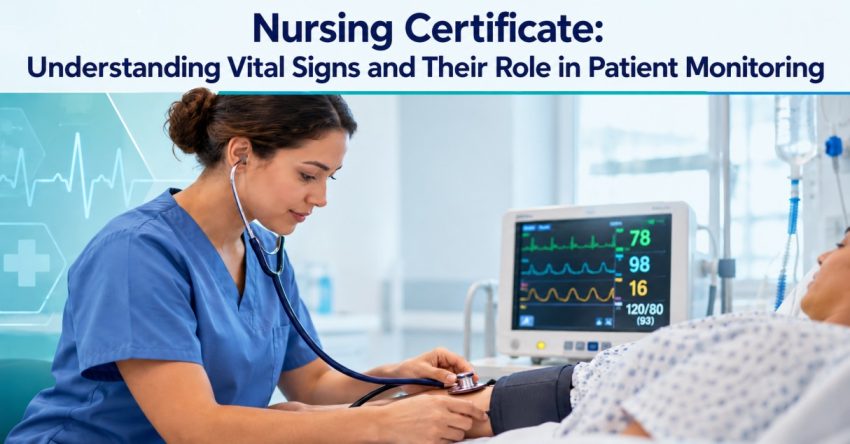
Vital signs are critical indicators of a patient’s basic physiology. Oxygen saturation, respiratory rate, pulse rate, blood pressure and temperature are monitored regularly in many healthcare settings. Knowing how to measure, record and report these observations in an accurate way is an important skill in the development of practical patient care skills. A nursing certificate can enable students to gain an understanding of these processes and how they apply to the normal monitoring of patients.

Table of Contents

Toggle
  • Understanding the main vital signs
    • Accurate Measurement Matters
    • Identifying changes in the condition of the patient
    • Record and report observations
    • Knowing the part the equipment plays
  • The link between Monitoring and Patient Safety
    • Frequently Asked Questions
      • What are vital signs in nursing?
      • What do you learn in a nursing certificate course?
      • Who can take a nursing certificate course?
      • Why do nurses check vital signs so often?
      • What does oxygen saturation actually tell you?
      • What does blood pressure show?
      • Can a reading be wrong?
      • Why does the measuring method have to be the same every time?
      • Does one abnormal reading mean something serious?
      • Why does documentation matter so much?
      • What should be written down with each reading?
      • What equipment is used to check vital signs?
      • How do nurses make sure their equipment is reliable?
      • How does vital sign monitoring keep patients safe?
      • Is a nursing certificate a good first step into healthcare?

Understanding the main vital signs

All of the vital signs are indicators of a patient’s condition. Temperature can give us clues as to changes that occur with infection or other conditions. Pulse rate is a measure of the activity of the heart and respiratory rate is a measure of the rate of breathing.

Blood pressure tells about the blood pressure in the arteries. O2 saturation percentage is the percentage of haemoglobin carrying oxygen in the blood. Combined, these can give useful clues to health care providers regarding changes in a patient’s condition.

Accurate Measurement Matters

Accurate measurement is essential to the usefulness of vital signs. Buildings, equipment placement, equipment positioning, equipment moves, improper positioning, and lack of proper procedures can impact readings.

Students should be taught the appropriate method for operating common monitoring equipment and applying appropriate clinical procedures. Standardised procedures to measure also enable comparisons to be made with data collected at various times.

Identifying changes in the condition of the patient

An abnormal reading does not necessarily give a complete picture of a patient’s health. Health care providers take the measurement as part of their assessment of symptoms, medical history, previous measurements, and other clinical factors.

When there is any major or unusual change, however, it may be necessary to evaluate such further. The ability to detect and report changes in a timely fashion is therefore a key part of patient monitoring.

Record and report observations

Documentation is an integral component of clinical care. Vital signs should be taken as per the healthcare facility’s procedures, and the appropriate time and measurement recorded.

Clear records enable members of the health care team to track trends and share information on significant changes. Failing to get a patient’s condition documented properly or accurately can make it harder to see how a patient’s condition has evolved over time.

Knowing the part the equipment plays

Various healthcare settings use digital thermometers, automated blood pressure monitor, pulse oximeter, etc. for monitoring. Students should be aware of the fundamentals of its function and its suitable application.

The training should also include checking the condition of equipment, following manufacturer/organisational instructions, and reporting any equipment concerns as appropriate. These practices help ensure accurate observations and patient safety.

The link between Monitoring and Patient Safety

Monitoring vital signs is not an ordinary job. Successful observations can help identify early signs of change in need of clinical intervention. They also make information available which can aid communication between various members of the healthcare team.

A nursing certificate can give learners a glimpse of these basic practices and help them understand the significance of accuracy, observation, documentation and timely reporting.

A good understanding of vital-sign monitoring is essential for future health care workers to gain knowledge of the importance of basic clinical observation in leading to organised, responsive and patient-centred care.

Frequently Asked Questions

What are vital signs in nursing?

They're the basic numbers that show how the body is doing: temperature, pulse, breathing rate, blood pressure and oxygen level.

What do you learn in a nursing certificate course?

Mostly the practical basics, like taking vital signs, monitoring patients, keeping records and reporting changes on time.

Who can take a nursing certificate course?

Anyone starting out in healthcare, from students to people planning a career in patient care.

Why do nurses check vital signs so often?

Small changes show up in these numbers early, which gives the team time to act.

What does oxygen saturation actually tell you?

It shows how much of the oxygen-carrying haemoglobin in the blood is doing its job.

What does blood pressure show?

It tells you how much pressure the blood puts on the artery walls as it moves.

Can a reading be wrong?

Yes, faulty equipment, bad positioning or skipping the proper steps can throw the numbers off.

Why does the measuring method have to be the same every time?

So readings taken at different times can be fairly compared.

Does one abnormal reading mean something serious?

Not necessarily, since nurses look at it alongside symptoms, history and earlier readings.

Why does documentation matter so much?

Clear records help the whole team spot trends and stay on the same page.

What should be written down with each reading?

The measurement itself and the time it was taken, following the facility's process.

What equipment is used to check vital signs?

Usually a digital thermometer, an automatic BP monitor and a pulse oximeter.

How do nurses make sure their equipment is reliable?

They check its condition before use, follow the instructions and flag any problems.

How does vital sign monitoring keep patients safe?

It helps catch problems early and keeps the healthcare team informed.

Is a nursing certificate a good first step into healthcare?

Yes, it teaches the everyday basics of careful observation, accurate records and quick reporting.

Also Read: Online Supply Chain Courses After Graduation: What Should You Know?

Leave a Reply Cancel reply

Your email address will not be published. Required fields are marked *

Send Query

    Recent Blog

    • Certificate Course in Human Resource: Learning the Fundamentals of Performance Management
    • Nursing Certificate: Understanding Vital Signs and Their Role in Patient Monitoring
    • Online Supply Chain Courses After Graduation: What Should You Know?
    • How to Choose the Right HR Certification Online Program
    • Career Opportunities After Completing a Masters in Supply Chain Management

    Categories

    • Business
    • Certificate Course in Healthcare Management
    • Certificate Course in Human Resource
    • CNA Training Course
    • CPHQ Certification
    • Diploma in Healthcare Management
    • Health Care Management Course
    • Health Certificate Online
    • Health Service Management Course
    • Healthcare
    • HealthCare Administration Course
    • Healthcare Courses
    • HR Management Certification
    • Human Resources Certificate Programs
    • Human Resources Certification Online
    • Infection prevention and control Program
    • Medical Coding Classes Online
    • Nurse Care Courses
    • Nursing Course
    • Online Hospital Administration Courses
    • Pharmacovigilance Certification
    • Supply Chain Management

    About e College

    Astron e College is an online academic vertical of the Astron Group, a globally operating Healthcare Consulting organization. The e College caters to the demand of working professionals both in the healthcare and non-healthcare sectors.

    Trending Courses

    • Certification in Healthcare Quality Management
    • Certification in Nursing Quality Management
    • Certification in Infection Prevention & Control Program
    • Certification in Nursing Audit

    Quick Links

    • About Us
    • Contact Us
    • News & Announcement
    • Login

    Social Links

    Table of Contents

    ×
    • Understanding the main vital signs
      • Accurate Measurement Matters
      • Identifying changes in the condition of the patient
      • Record and report observations
      • Knowing the part the equipment plays
    • The link between Monitoring and Patient Safety
      • Frequently Asked Questions
        • What are vital signs in nursing?
        • What do you learn in a nursing certificate course?
        • Who can take a nursing certificate course?
        • Why do nurses check vital signs so often?
        • What does oxygen saturation actually tell you?
        • What does blood pressure show?
        • Can a reading be wrong?
        • Why does the measuring method have to be the same every time?
        • Does one abnormal reading mean something serious?
        • Why does documentation matter so much?
        • What should be written down with each reading?
        • What equipment is used to check vital signs?
        • How do nurses make sure their equipment is reliable?
        • How does vital sign monitoring keep patients safe?
        • Is a nursing certificate a good first step into healthcare?
    → Index