
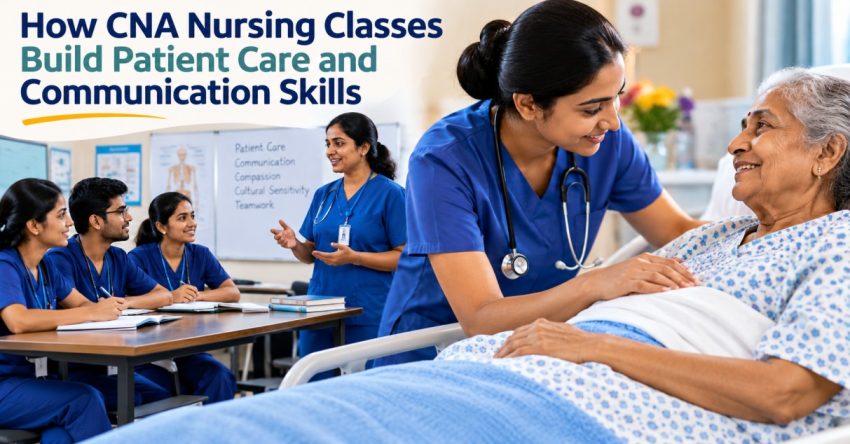
Being a certified nursing assistant is not a job that requires just some basic health care knowledge. CNAs will regularly be working with patients, nurses, doctors and other members of the health care team. They can help with the daily tasks, watch for a patient’s condition and help in the routine care, etc., CNA nursing classes can assist students in acquiring the skills and communication required to assist them in performing these duties with confidence and professionalism.
Essential Patient Care Skills, Developed:
Patient care is an integral component of CNA nursing classes. Students are taught to support patients to maintain dignity, comfort and safety with their daily activities.
Training may include personal hygiene, mobility support, positioning, feeding and basic patient support. Students are also taught the need to adhere to the correct procedures when working with people of varying physical abilities.
Through practical instruction, students will gain insight into how these skills are implemented in authentic healthcare settings beyond classroom settings.
Understanding Patient Safety
In every day care of patients, safety is important. CNA nursing courses will give students an understanding of the activities they can engage in to minimize preventable risks.
Students can be trained on safe moving and positioning, infection prevention, proper hygiene and use of basic equipment. By knowing these practices, a nursing assistant in training will be able to identify the value in abiding by protocol when working with patients.
Building Communication Skills
Communication is an essential part of patient care. Nursing assistants should be knowledgeable of patient concerns and know how to provide information and explanations about routine activities and communicate observations with other healthcare workers.
CNA nursing classes can provide opportunities to practise verbal and non-verbal communication. Students have the opportunity to listen attentively, ask relevant questions and communicate effectively in a respectful way.
These skills are especially relevant when dealing with patients that are not familiar or comfortable with their environment, and may be feeling anxious.
Empathy and Working Relationships with Others
Patients can have varying physical, emotional and communication needs. Training can enable students to be more aware of how to be patient, respectful and considerate towards others.
Students can learn about various patient care scenarios through role playing, classroom discussions, and activities. These experiences can stimulate learners to think about how tone, body language and words can affect interactions.
How to Observe and Report
CNAs also typically encounter patients in a routine manner, and may become aware of any changes in their condition or behaviour. Being able to share pertinent information with the appropriate health care individual is a critical job skill.
CNA nursing classes can help students focus on detail and provide accurate information in their assigned duties. This helps to ensure effective communication among nursing assistants and other healthcare personnel.
Theory with Practical Training
Learning and practice form an integral part of the CNA nursing classes. Learning through classroom instructions is conducted in order to introduce the students to the ideas and processes. On the other hand, practical classes are conducted to test ideas and processes in controlled environments.
This can help students learn patient-care routines and build confidence to do tasks right. It also provides opportunities for learners to reflect on areas which they require further practice.
Conclusion
CNA nursing classes may be able to provide aspiring nursing assistants with the patient-care and communication skills needed inside the healthcare setting. Students will develop safe, respectful and effective communication and care work with patients through theory, practice and supervised activities. These skills are essential for preparing to enter a patient care career and further education in the healthcare field.
Also Read: Certificate Course in Human Resource: Learning the Fundamentals of Performance Management