
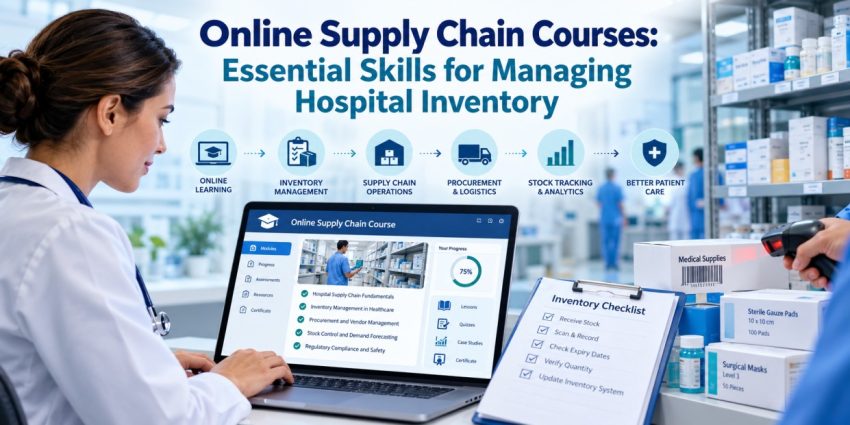
To maintain uninterrupted patient care, hospitals require a constant supply of medicines, medical devices, surgical instruments as well as day to day consumables. Stock shortages, medicines expiring, the need to buy medicines that are not needed and delay in treatment are all possible consequences of poor inventory management. Those involved in the delivery of hospital supplies need to be aware of maintaining adequate quantities whilst at the same time making certain that key products are not lacking. Supply chain education in healthcare facilities could be taught through online supply chain courses to give students the knowledge of basic principles of inventory planning, procurement, storage, and distribution.
This course provides an understanding of Hospital Inventory Management.
Inventory management in hospitals is the process of monitoring supplies received, stored and issued in the hospital until they are consumed. In healthcare, inventory can be different from other industries because of products with expiration dates, special storage conditions and strict handling precautions.
Online supply chain courses can help students learn about the various types of hospital supplies, such as pharmaceuticals, personal protection equipment, laboratory supplies, and surgical supplies. Knowing these categories enables professionals to identify why they might need to proceed with a different purchasing, storage and monitoring process for each.
Essential Skills for Managing Hospital Inventory
Running a good inventory system demands analytical, organizational and operational skills. Healthcare supply chain training can educate about multiple key areas.
1. Stock should be monitored and replenished.
Hospitals need to have adequate supplies on hand but not have too much money tied up in inventory that is not being used. Students can investigate how to keep tabs on stock levels, determine reorder levels, and discover what to purchase immediately.
Demand forecasting plays a crucial role especially if there is a fluctuation in patients or medical supplies as they may need to be different at various points in time.
2. Expiry Date and Batch Management
Some medical products, vaccines and medicines have a limited shelf life. There should be dependable systems for inventory teams to track expiration dates and avoid issuing products past their expiration dates for patient care.
A first expiry first out (FEFO) process ensures that the products with the earliest expiry date are used first, provided it is given and as per clinical and storage requirements.
3. Procurement and Supplier Coordination
The hospital supply chain professionals collaborate with the vendors to ensure they have the appropriate products available in the correct amount, at an appropriate time and place. Training may include introducing learners to the concepts of purchase planning, supplier evaluation, delivery timetables and procurement documentation.
These skills can help healthcare facilities make more efficient avoidable purchasing delays and better supply of critical supplies.
4. Storage and Inventory Accuracy
Medical supplies need to be stored under suitable conditions. Some products must be kept at a controlled temperature, others must be protected from moisture and contamination and still others from physical damage.
Students may also gain knowledge of stock counting, inventory management, barcode systems and digital tracking technologies. Keeping accurate records helps to spot discrepancies and make improved buying decisions.
How Online Supply Chain Courses Support Healthcare Professionals
Courses in the online supply chain provide flexibility with respect to inventory management concepts, without having to turn down current employment. Learners can learn by watching lessons, reading about cases, taking tests and exams, and getting practical examples.
The online supply chain courses might be relevant to the future Hospital Administration, Pharmaceutical Logistics, procurement assistant, healthcare operation personnel. The depth of teaching and recognition of the industry, however, ranges among providers.
Choosing the Right Course
Check the syllabus before enrolling to see if it includes information on healthcare procurement, expiry management, stock control, demand forecasting and storage. Seminars with case studies in the healthcare sector can help students grasp the application of supply chain concepts in a healthcare environment.
It is also important to ensure the provider has the correct credentials, methods of assessing students and recognised certificates. Many jobs will require you to have relevant work experience and qualifications, with the opportunity to gain theoretical knowledge from online courses.
Conclusion
Having effective stock control in a hospital is essential for ensuring patients are safe, and that operations run efficiently. By taking stock management courses online, students will gain an understanding of how to monitor stocks, plan for purchasing, manage expiry dates and ensure accurate stock levels. This, with the right practical experience, will put aspiring professionals in a good position to take on roles in hospital purchasing, healthcare logistics and stock management. The first step to understanding the specific requirements of stock management in a hospital is to pick a course that has relevant healthcare content.
Frequently Asked Questions
Also Read: Nursing Assistant Online Course: Career Opportunities in Hospitals and Elderly Care