
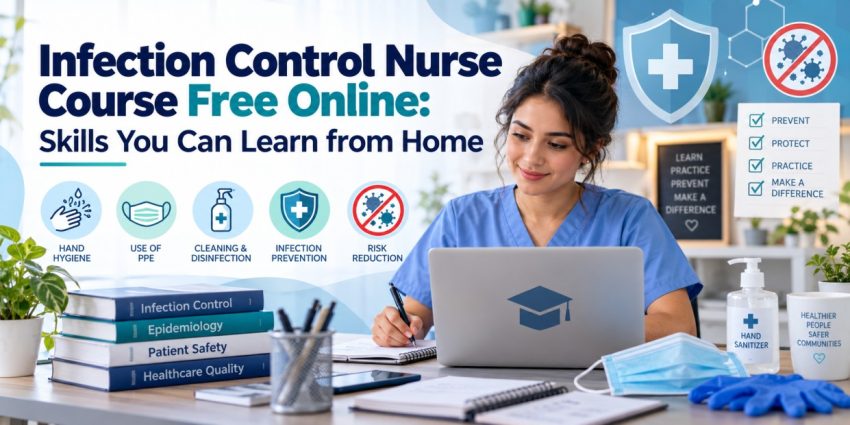
Preventing infections is an essential part of delivering safe healthcare. Nurses are an important part of the hospital, clinic, and other healthcare environments where they are responsible for helping to minimize the spread of infections. An infection control nurse course free online may be a good first step for professionals looking to build upon their knowledge, but without having to take time away from their work. These courses educate students on infection control, hygiene and patient safety, which will help them provide better care for patients.
Knowing the basics of infection prevention
First of all, learners can learn through online infection control training how infections are spread. HAPIs are infections that may occur during treatment for the patient, and may also present a risk to the healthcare worker.
Common routes of transmission may be discussed in online learning modules, such as direct contact, indirect contact, droplets and airborne particles. A nurse’s knowledge of these routes can enable him/her to identify potential risks and take appropriate precautions in various clinical settings.
Learners can also receive information about standard precautions, which are used for patient care both when an infection is known or suspected.
Learn basic skills at home which will help you in your job.
And infection control nurse course free online can present a number of practical skills as an integral component of the course.
- Hand hygiene: Knowledge of proper hand washing procedures and alcohol based hand rubs.
- Personal protective equipment (PPE): Knowing when and how to wear gloves, masks, gowns and eye protection as needed due to exposure risk.
- Disposal of waste in a safe manner: Knowledge of the procedures for the safe separation and disposal of health-care waste.
- Cleaning and disinfection: To understand the difference between cleaning, disinfection and sterilisation and when they are used.
- Infection surveillance: Building an awareness of the introduction of infection surveillance in healthcare facilities.
Courses vary in depth of training. These concepts can be explained in free introductory programmes, but not necessarily with supervised practical experience or professional qualification.
Educating on Infection Control Measures
To prevent infection, all procedures must be followed on a regular basis. Online courses can help nurses grasp why protocols exist, and why they help to keep patients safer.
Content could include: isolation precautions, respiratory hygiene, safe handling of sharps, and what to do if exposed to potentially infectious materials. Learners can also discuss the value of reporting incidents and adhering to workplace procedures.
The use of these lessons may help nurses identify situations that call for extra precautions. But the content of a course should be in addition to, not in place of, the infection control policies and training from their healthcare employer.
The advantages of online courses are plentiful and include the following:
Online learning provides flexibility to nurses who are juggling work with education. Learners may access and view recorded lessons, reading material, quizzes and assessments at their own time and place, depending on the provider.
Other possible advantages entail:
- Training courses that are flexible to allow for shift working.
- Individual revision opportunities of key concepts.
- Exposure to the current infection prevention terminology and guidelines.
- A base level of knowledge to build upon for further infection control education.
Learners should research the course to see if it actually is free, if it includes assessments and if a certificate has any recognised professional value.
Selecting the appropriate course; Course selection; Course options and choice
All free courses are not created equal. Take time to think about the relevance of a programme before you choose it, and the learning outcomes you will achieve.
Search for courses on hand hygiene, transmission-based precautions, PPE, environmental cleaning, waste management and infection surveillance. Determine if the content is supported by reputable health care advice and if the health care provider makes it clear what is required to qualify for certification.
While a nurse course on infection control is available online for free for some of the basic information, other qualifications, supervised experience or employer approved training may be required for nurses looking for a specialist role. Please verify the requirements for the job you plan to pursue before taking any online certificate courses.
Conclusion
Knowledge, consistency, and detail are all essential components of infection prevention which is a key nursing role. This infection control nurse course free online will enable them to build a base knowledge of hygiene, protective equipment, safe waste disposal and infection prevention without leaving home. These skills can be used to enhance professional development and patient and healthcare worker safety. Nurses can use credible learning materials and apply the learning to their workplace training to develop their knowledge of infection control and readiness for future learning in this vital area of health care.
Frequently Asked Questions
Also Read: HR Courses Online: How Digital Learning Supports Flexible Professional Development