
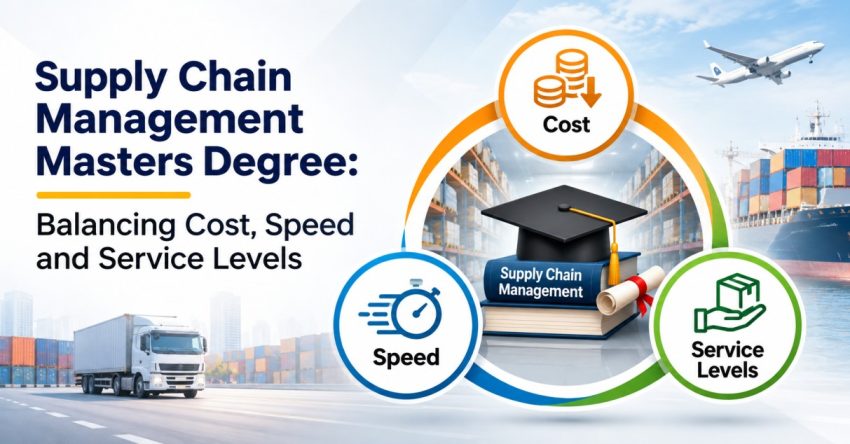
There are many decisions made along the supply chain that directly impact business decisions on buying, manufacturing, storage and delivery. Companies need to control operational costs while maintaining suitable delivery timelines and meeting customer expectations. Sometimes these priorities may conflict with each other and making decisions in supply chain is not always as straightforward as cost saving. A supply chain management masters degree can help students grasp that costs, speed, and service levels can all be taken into account when planning supply chain operations.
Insight in the Cost-Side of Supply Chain Decisions
Cost management is one of the important factors in the supply chain planning. The costs may be incurred in procurement, transportation, warehouse, stock holding, labour and order processing. However, cutting back on one cost does not necessarily mean that the supply chain is more efficient.
Choose a lower-cost method of transport, which is likely to take longer. Likewise, having very low inventories can decrease storage costs, but may make it more difficult to respond rapidly to unexpected demand. Students will be taught in the study of supply chain management to consider these balancing points before operating decisions.
Why Speed Matters
Speed has an impact on customer satisfaction, production continuity, and inventory needs. Businesses can become more responsive to demand faster by faster transportation, shorter procurement cycles and efficient warehouse processes.
But there are cost implications when it comes to speed. Extra investments such as expedited shipping, extra warehouse resources or having inventory closer to customers are likely to be necessary. It’s, therefore, necessary for professionals in the supply chain to identify where the service can be quicker and deliver operational or customer benefits.
Ensuring that the Service Levels are Appropriate
Service levels are the level of reliability of a supply chain in meeting expectations. This can be anything from products available, delivery time, correct orders, or the quick response to customers’ needs, depending on the business.
Not all services are necessarily required for all products or all customers. A business might want to try a quick delivery mechanism for products that are of critical importance, but choose a slower method for those of more regular demand. The differences can be helpful to companies in resource allocation based on their business priorities.
Building the Capabilities and Skills to Work with the Three Priorities Together
An important issue in supply chain management is to find the balance on cost, speed and service. Sometimes, enhancing one aspect can impact on the other.
A supply chain management masters degree equips students with a range of concepts and skills, including demand forecasting, inventory planning, procurement, logistics and supply chain analytics. These spaces enable future professionals to consider various options and the impact of decisions made in their operations on the larger supply chain.
For example, improved demand forecasting can assist companies to keep the correct stock levels. This can improve unnecessary holding costs and decrease the likelihood of stock-outs which might have an impact on the quality of service.
Data for Better Decisions:
Today’s supply chains capture data in procurement, transportation, warehouse and sales and customer order. This data can be used to understand delays, recurring expenses, inventory trends, as well as gaps in service levels.
Pupils have the opportunity to learn analytical and problem-solving techniques to enable them to apply this information when assessing the performance of a supply chain. Rather than making decisions based on their own experiences, companies can begin to notice patterns in the data, and make well-informed planning decisions.
Classroom to Real World Challenges in the Supply Chain
To achieve the balance between costs, speed and service, one must understand the relationship of various activities in the supply chain. Purchasing decisions as well as stock, transport and warehouses can have ramifications throughout the operation.
A supply chain management masters degree can give students a structure of understanding these relationships and tools to assess operational trade-offs. This data can also be valuable for aspiring professionals in their approach to making decisions about the supply chain regarding efficiency, responsiveness and customer needs.
Also Read: Online Supply Chain Courses: Essential Skills for Managing Hospital Inventory