
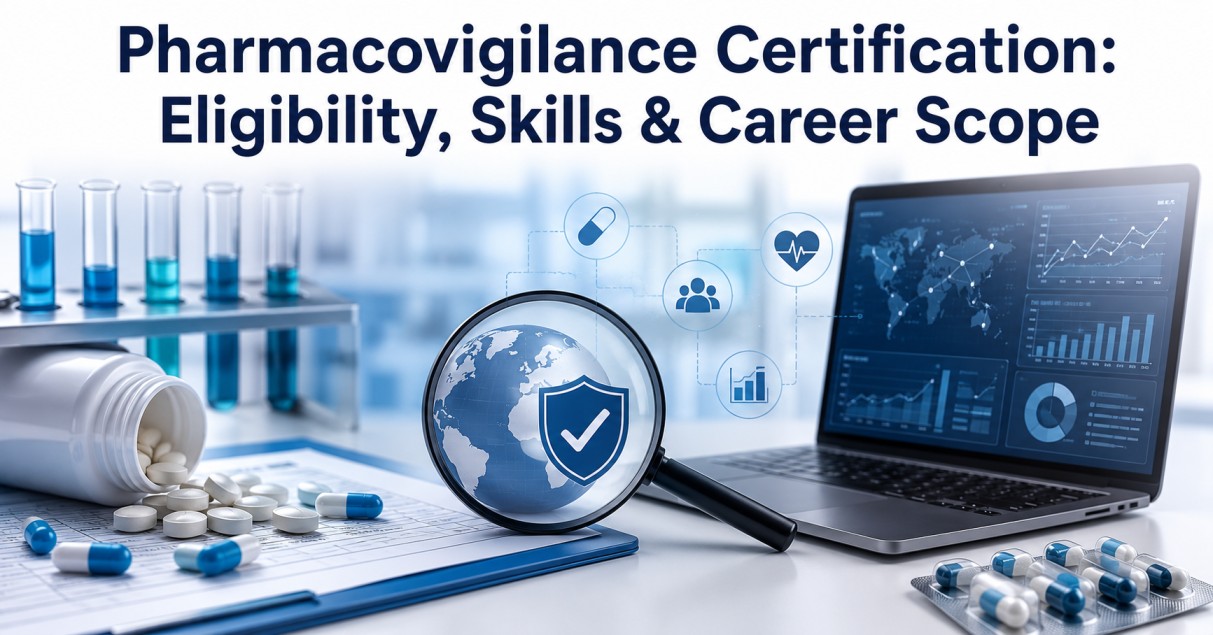
Pharmaceutical industry and healthcare are tasked with more than just creating drugs; they are also involved in making sure that these drugs remain safe once they enter the market. Monitoring adverse drug reactions, risk assessment, and patient safety have been key aspects of the process. With the rising number of opportunities in this field, there has been a need for training in the same. Obtaining a Pharmacovigilance Certification gives one the necessary skills to participate in drug safety.
Pharmacovigilance Certification Course Eligibility Criteria
The pharmacovigilance certification course is applicable to those having academic qualifications in life sciences, pharmacy, medicine, nursing, biotechnology, microbiology, biochemistry, and various other medical-related fields. New graduates who wish to join the pharmaceutical industry often opt for certification courses as a means of improving their employability and gaining industry knowledge.
Professionals already working and aiming for a promotion or change in job role may also benefit from certification programs. Many of such programs are tailored to cater to the needs of learners by offering flexible timings.
Although different institutions may have different criteria, having an introductory knowledge of medical terminologies and human biology will make it easier for learners to understand the concepts of pharmacovigilance.
Skills You Can Acquire With The Course
A properly designed pharmacovigilance course will help the learner acquire full knowledge on the drug safety monitoring from the product development process right through its lifetime. This includes the knowledge on identification, recording, evaluation and reporting of adverse drug reactions using the guidelines issued by various regulatory authorities around the world.
This course will enable participants to acquire skills on case processing, medical coding, literature searches, signal detection, risk management and pharmacovigilance database management. Being familiar with the different regulatory requirements and documentation processes, learners can play an effective role in any pharmaceutical firm, contract research organization or healthcare facility.
Pharmacovigilance Certification also improves the individual’s analytical skill, precision, communication and problem solving skills as this discipline entails analysis of information and making reports. This makes the professional skills very important for such individuals in order to be compliant and safe.
Career Scope in Pharmacovigilance
The pharmaceutical industry continues to expand globally, creating strong demand for professionals specializing in drug safety and regulatory affairs. Pharmaceutical companies, biotechnology firms, clinical research organizations, hospitals, regulatory agencies, and healthcare consulting firms regularly recruit trained pharmacovigilance professionals.
Career opportunities include positions such as drug safety associate, pharmacovigilance executive, medical reviewer, safety data analyst, case processing specialist, regulatory affairs associate, quality compliance officer, and clinical safety coordinator. With experience, professionals can progress into leadership roles overseeing pharmacovigilance operations, regulatory compliance, and global drug safety programs.
The increasing focus on patient safety, stricter regulatory requirements, and continuous post-marketing surveillance ensures that pharmacovigilance remains an essential function within the healthcare sector, providing stable long-term career opportunities.
Conclusion
Pharmacovigilance has emerged as one of the most essential fields in today’s health care industry because it helps to keep medicines safe and effective at all times during their lifespan. A Pharmacovigilance Certification can prove to be very helpful for learners who want to increase their specialization, gain industry skills and boost up their professional credentials. If you are a beginner or have been working in the field of health care for years now, you can definitely benefit from certification.
Also Read: Supply Chain Management Course vs Degree: Which One Should You Choose